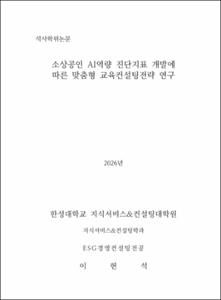
소상공인 AI역량 진단지표 개발에 따른 맞춤형 교육컨설팅전략 연구
= A Study on Customized Education and Consulting Strategies Based on the Development of AI Competency Assessment Indicators for Small Business Owners
- Type
- Thesis
- Abstract
- This study aims to develop an AI competency diagnostic index for small business owners and propose tailored AI education-consulting strategies based on this diagnostic system. To construct a customized AI education model, the research examines key factors of AI education consulting that influence expected educational outcomes and empirically analyzes small business owners’ AI education needs.
Although small businesses constitute a critical pillar of the national economy in Korea, they remain relatively marginalized in adopting new technologies amid the rapid transition from a digital to an AI-driven era. Despite several AI education programs being introduced, the current initiatives still lack systematic level-diagnosis and demand assessment procedures, resulting in largely uniform curricula with uncertain effectiveness. Against this backdrop, and considering the limited prior research on AI education for small business owners, this study seeks to address these gaps.
A survey was administered to 352 small business operators in the Seoul metropolitan area across food service, retail, and service industries. AI needs and preferred learning stages were analyzed across five managerial dimensions—SNS marketing, store operation, profit and loss management, commercial district analysis, and business information—with a total of 50 sub-indicators evaluated both overall and by cluster.
In the first stage, regression analysis revealed that all factors of AI education environment and AI education quality significantly influenced expected outcomes such as perceived sales potential and managerial confidence, except for two paths (AI instructor’s field understanding → sales potential, and field applicability of AI education → managerial confidence). In the second stage, four AI-readiness groups (IT and AI utilization leaders, early-stage entrepreneurs with AI interest, passive AI interest group, and mid-stage entrepreneurs with AI conversion interest) were classified, and results indicated no statistically significant differences across groups in expected AI education outcomes, suggesting that all groups share similar expectations regarding the benefits of AI education. In the third stage, preferred AI learning topics and stages were examined for each group and indicator, and tailored education strategies were suggested accordingly.
Theoretically, this study contributes by developing an AI-specific competency diagnostic framework for small business owners and establishing customized education-consulting strategies grounded in adult learning theory and innovation diffusion theory. Empirical findings verified the significance of AI education environment and quality factors, identified group characteristics based on AI adoption levels, and confirmed that introductory, practice-oriented instruction constitutes the most effective starting point.
Practically, the results highlight the necessity of adopting diagnostic -based and customized AI education approaches for various stakeholders involved in small business AI support—including local governments, support agencies, instructors, and consultants. The findings further indicate that aligning AI education with the distinct characteristics and needs of each group can enhance educational effectiveness.
【Keywords】 Small Business Owners, AI Competency, AI Diagnostic Indicators, Education Quality, Educational Performance|본 연구는 소상공인 AI 역량 진단지표 개발에 따른 맞춤형 교육컨설팅 전략을 연구하는 것을 목적으로 한다. 연구수행을 위해 소상공인 맞춤형 AI 교육컨설팅 전략을 설계하고자 AI 교육컨설팅이 AI 교육 기대성과에 미치는 변수를 확인하고자 한다. 아울러 소상공인들이 선택한 AI 교육 요구사항을 진단하는 실증적 분석을 진행하고자 한다.
우리나라 소상공인은 국민경제의 중요한 축을 담당하고 있음에도 최근들어 디지털 시대를 넘어 AI 시대로의 빠른 전환에도 신기술 도입에 대체적으로 소외되어 있는 실정이다. 이에 따라 현재 소상공인 AI 교육이 진행되고는 있으나 수준 진단이나 교육 희망 영역에 대한 수요조사 등의 절차가 이루어지지 않고 다소 획일적 교육으로 그 효과성 우려가 있고 소상공인과 AI 교육에 대한 선행연구도 미흡한 상황에서 본 연구를 수행하게 되었다.
실증분석을 위해 수도권에서 음식점업, 소매업, 서비스업을 운영하는 총 352명 대상으로 설문조사를 하여 본 연구의 분석자료로 활용하였다. 분석에서는 실제 경영활동(SNS 마케팅, 매장운영, 손익관리, 상권분석, 정보제공)을 5개로 구분하고 그 하위지표 총 50개를 전체 및 군집별로 AI 필요 수준 및 선호 교육단계를 분석하였다.
1단계 연구에서는 AI 교육컨설팅 교육환경요인과 AI 교육컨설팅 교육품질요인이 사업매출 가능성과 경영활용 자신감과 같은 AI 교육컨설팅 기대성과에 미치는 영향을 분석한 결과 AI 교육 강사 현장이해도와 사업매출 가능성, AI 교육 현장실무 적합성과 경영활용 자신감 등 2개의 가설을 제외하고는 모두 유의한 영향을 미치는 것으로 나타났다. 그리고 2단계 연구에서는 AI 수용성 수준에 따른 네 개 집단(IT 및 AI 활용선도형, 창업초기 AI 전환관심형, 소극적 AI 관심형, 창업중기 AI 전환관심형)으로 분류하고 분석한 결과 기대성과 종속변수에 미치는 영향이 네 집단간에 통계적으로 유의한 차이가 없는 것으로 모든 집단이 AI 교육을 통한 성과에 기대하고 있다는 것을 확인할 수 있었다. 마지막으로 3단계 연구에서는 집단별로 선호하는 AI 교육 지표영역의 단계별 수요를 분석하여 각 집단별 그리고 각 지표영역별 교육전략을 제시하였다.
이론적 시사점으로는 소상공인 AI 역량 진단지표를 개발하고 이에 따른 맞춤형 교육컨설팅 전략을 수립하였고, 성인학습이론과 혁신수용이론을 기반으로 AI 교육환경, AI 교육품질 요인의 유의성을 검정하고 AI 수용수준별 집단 차이를 확인하고 집단별 AI 교육 수요를 분석하여 우선적으로 초급 실습형 중심의 교육이 효과적임을 확인하였다. 실무적 시사점은 다음과 같다, AI 교육을 둘러싼 모든 이해관계자, 즉 지자체 및 소상공인지원 유관기관 시설담당자, 교육담당자, 교육강사, 소상공인 컨설턴트에게 분석결과에 따라 소상공인의 AI역량 진단 및 이에 따른 집단별 맞춤형 교육과 컨설팅이 필요하다는 것을 확인할 수 있었다. 아울러 각 집단별 특징이나 요구사항에 맞추어서 AI 교육을 실시하게 되면 그 효과가 증대될 것으로 확인되었다.
【주요어】소상공인, AI 역량, AI 진단지표, 교육품질, 교육성과
- Advisor
- 정병호
- Department
- 지식서비스&컨설팅학과
- Issued Date
- 2026
- Publisher
- 한성대학교 지식서비스&컨설팅대학원
- Keyword
- 소상공인, AI 역량, AI 진단지표, 교육품질, 교육성과
- Appears in Collections:
- 지식서비스&컨설팅학과 > 2. Thesis
- Authorize & License
-
- Authorize공개

- Files in This Item:
-
-
Download
 TH_P1A1A1_소상공인 AI역량 진단지표 개발에 따른 맞춤형 교육컨설팅전략 연구 .pdf
기타 데이터 / 3.35 MB / Adobe PDF
TH_P1A1A1_소상공인 AI역량 진단지표 개발에 따른 맞춤형 교육컨설팅전략 연구 .pdf
기타 데이터 / 3.35 MB / Adobe PDF
-
Items in Repository are protected by copyright, with all rights reserved, unless otherwise indicated.