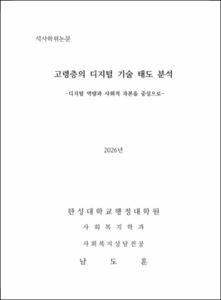
고령층의 디지털 기술 태도 분석
= An Analysis of Older Adults’ Attitudes Toward Digital Technology: Focusing on Digital Competence and Social Capital
- Type
- Thesis
- Alternative Title
- 디지털 역량과 사회적 자본을 중심으로
- Abstract
- 본 연구는 고령층의 디지털 역량과 사회적 자본이 디지털 기술 태도에 미치는 영향을 분석하였다. 한국지능정보사회진흥원(NIA)의 디지털 격차조사 자료를 활용하여, 65세 이상 고령층 1,405명을 대상으로 선형회귀분석(OLS)을 실시하였다. 분석 결과, 디지털 역량 중 PC 역량(β = 0.0792, p = .007)과 모바일 역량(β = 0.1136, p < .001) 모두 디지털 기술 태도에 유의한 정(+)의 영향을 미치는 것으로 나타났다. 사회적 자본의 하위 요인인 신뢰·지원(β = 0.1534, p < .001)과 연결감·참여(β = 0.2114, p < .001) 역시 유의한 영향을 보여, 사회적 관계망이 활발할수록 디지털 기술 태도가 긍정적으로 형성되는 경향을 보였다.
통제변수 중에서는 연령(β = -0.0095, p = .003)이 유의한 음(-)의 영향을 나타내 고령일수록 디지털 태도가 낮은 경향이 확인되었다. 성별은 유의하지 않았으며(p = .406), 학력은 대졸 이상 집단에서 한계적 유의성을 보였다(p = .079). 또한 경제활동 관련 변수 중 소득증대 요인은 디지털 태도에 정(+)의 영향을 미쳤다(β = 0.0678, p = .004).
모형의 전체 설명력은 R² = .251(Adj. R² = .242)로 나타났으며, F(17, 1387) = 27.39, p < .001 수준에서 통계적으로 유의하였다. 이는 디지털 역량과 사회적 자본이 함께 투입될 때 디지털 기술 태도의 약 24%를 설명함을 의미한다. 이러한 결과는 고령층의 디지털 기술 수용이 기술적 능력뿐 아니라 사회적 관계망의 폭과 질에 의해 강하게 영향을 받음을 시사한다.
【주요어】: 디지털 역량, 사회적 자본, 디지털 기술 태도, 고령층, 회귀분석|This study examined the effects of digital competence and social capital on digital technology attitudes among older adults in South Korea. Using data from the National Information Society Agency’s Digital Divide Survey, a sample of 1,405 adults aged 65 and older was analyzed through ordinary least squares (OLS) regression. The results revealed that both PC competence (β = 0.0792, p = .007) and mobile competence (β = 0.1136, p < .001) had significant positive effects on digital attitudes. Similarly, two components of social capital—trust and support (β = 0.1534, p < .001) and connectedness and participation (β = 0.2114, p < .001)—were also significant, suggesting that stronger social networks are associated with more favorable digital attitudes.
Among the control variables, age (β = -0.0095, p = .003) had a significant negative effect, indicating that older individuals tend to have lower digital attitudes. Gender was not significant (p = .406), while education showed marginal significance for the college-educated group (p = .079). Economic factors such as income increase had a positive association with digital attitudes (β = 0.0678, p = .004).
The overall model fit was R² = .251 (Adj. R² = .242), and the model was statistically significant, F(17, 1387) = 27.39, p < .001. These findings indicate that both digital competence and social capital jointly explain about 24% of the variance in digital technology attitudes. The results emphasize that the digital acceptance of older adults is not only shaped by technological ability but also strongly influenced by the breadth and quality of their social relationships.
【Keywords】digital competence, social capital, digital technology attitude, older adults, regressionanalysis
- Advisor
- 최천근
- Department
- 사회복지학과
- Issued Date
- 2026
- Publisher
- 한성대학교 행정대학원
- Authorize & License
-
- Authorize공개

- Files in This Item:
-
-
Download
 TH_N1A1A1_고령층의 디지털 기술 태도 분석 .pdf
기타 데이터 / 1.14 MB / Adobe PDF
TH_N1A1A1_고령층의 디지털 기술 태도 분석 .pdf
기타 데이터 / 1.14 MB / Adobe PDF
-
Items in Repository are protected by copyright, with all rights reserved, unless otherwise indicated.