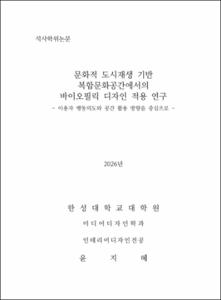
문화적 도시재생 기반 복합문화공간에서의 바이오필릭 디자인 적용 연구
= A Study on the Application of Biophilic Design in Complex Cultural Spaces Based on Cultural Urban Regeneration: Focusing on Users' Behavioral Intentions and the Direction of Space Utilization
- Type
- Thesis
- Alternative Title
- 이용자 행동의도와 공간 활용 방향을 중심으로
- Abstract
- 현대 도시는 급속한 산업화와 도시 계획의 재편으로 인해 다양한 유휴공간이 발생하였으며, 이들은 문화적 가치가 결합된 복합문화공간으로 전환하는 움직임이 활발히 이루어지고 있다. 본 연구는 유휴공간을 복합문화공간으로 재생한 국내 사례를 중심으로, 바이오필릭 디자인 구성요소와 문화적 도시재생 공간 특성이 이용자의 행동의도에 미치는 영향을 분석하고, 이 과정에서 회복환경지각과 장소애착의 조절효과를 함께 검증하고자 하였다. 1차 사전 조사 결과, 자연광, 식재, 자연 재료 사용 등 자연 경험 요소의 선호도가 가장 높게 나타났고, 문화적 도시재생 특성은 체험형 콘텐츠와 연결될 때 공간 정체성 인식이 강화되는 것으로 확인되었다. 이를 바탕으로 1차 설문에서 활용된 바이오필릭 디자인 구성요소와 문화적 도시재생 공간 특성을 기반으로 수정 및 보완하여 본 연구의 설문 측정항목을 구성하였다.
본 연구의 분석을 위한 개념적 모형은 바이오필릭 디자인 구성요소와 문화적 도시재생 공간 특성을 독립변수로 설정하고, 회복환경지각과 장소애착을 조절변수로, 행동의도를 종속변수로 설정하였다.
연구 대상은 유휴공간을 복합문화공간으로 재생한 국내 사례 5곳(마포문화비축기지, 노들섬 복합문화공간, 윤동주문학관, 성수연방, 서울식물원)을 선정하였다. 현장 및 온라인 설문조사를 통해 국내 일반인 총 200명을 대상으로 설문조사를 실시하였다. 그 중 ‘복합문화공간을 거의 이용하지 않는다’에 응답한 50명은 제외한 후 ‘복합문화공간을 월 1회 이상 이용하는 이용자’ 150명을 유효 표본으로 하여, IBM SPSS Statistics 26.0 프로그램을 활용해 신뢰도 및 타당도 검증, 기술통계, 차이검정, 상관분석, 선형혼합모형(Linear Mixed Model)을 통해 가설을 검증하였다.
분석 결과, 바이오필릭 디자인 요소와 문화적 도시재생 특성은 이용자의 행동의도에 유의한 정(+)의 영향을 미치는 것으로 나타났다. 조절변수인 회복환경지각과 장소애착 역시 행동의도를 증진시키는 주요한 심리적 요인으로 확인되었으나, 변수 간 상호작용에 따른 조절효과는 부분적으로만 나타나 특정 조건에서만 차별적으로 작동함을 확인하였다. 즉, 이용자의 회복감 인식이 높을수록 바이오필릭 디자인이 행동의도에 미치는 긍정적 효과는 더욱 강화되는 것으로 나타났다. 반면, 장소애착의 경우 이용자 유형에 따라 상이한 작용 패턴을 보였으며, 일부 관계에서는 행동의도에 미치는 영향력이 완화되는 경향을 보였다. 한편, 문화적 도시재생 특성은 행동의도를 형성하는 직접적인 유효변수임을 확인하였으나, 문화적 도시재생 특성과 회복환경지각 간의 상호작용 효과는 통계적 유의성이 확보되지 않아, 두 변수의 결합에 따른 조절 효과보다는 각 요인의 독립적 영향력이 더 지배적인 것으로 분석되었다.
이에 따라 본 연구에서 내린 결론은 다음과 같다. 첫째, 복합문화공간 내 이용자의 심리적 회복을 촉진하기 위해, 직접적 자연 경험 요소의 도입과 확장이 필요하다. 둘째, 유휴공간을 재생한 복합문화공간의 디자인은 산업적 흔적을 보존하거나 전시하는 수준을 넘어, 장소가 지닌 기억과 이야기가 이용자가 직접 경험할 수 있는 공간 구조로 확장되어야 한다. 셋째, 이용자의 장소애착 수준에 따라 경험을 달리 제공하는 이용자 유형별 체류 경험 전략을 제시해야 한다. 넷째, 회복을 유도하는 환경 요소와 문화적 체험 요소가 서로 분리되지 않도록 공간 이용 과정이 하나의 연속적인 흐름으로 인식될 수 있는 동선 체계를 구축해야 한다.
본 연구는 공간 이용자의 심리 및 행동의도에 초점을 두어, 유휴공간을 활용한 복합문화공간에서의 바이오필릭 디자인과 문화적 도시재생 공간 특성의 디자인 가능성을 탐색하는 데 기초적 의의를 지닌다. 다만, 분석 자료가 횡단면적 설문을 통한 이용자의 주관적 인식 평가를 기반으로 진행되었다는 점에서 한계가 있었다. 후속 연구에서는 이용자의 물리적 환경 데이터와 시간의 흐름에 따른 이용자의 인식 및 장소애착 변화를 장기적으로 관찰한 연구가 수행될 때 유휴공간을 재생한 복합문화공간 디자인 전략이 실증적으로 발전할 수 있을 것이다.
【주요어】유휴공간, 복합문화공간, 바이오필릭 디자인, 문화적 도시재생, 행동의도|Modern cities have witnessed the emergence of various idle spaces due to rapid industrialization and the reorganization of urban planning. These areas are increasingly being transformed into complex cultural spaces that integrate cultural values. Centering on domestic cases where such sites were regenerated, this study analyzed the effects of biophilic design elements and the characteristics of cultural urban regeneration on users’ behavioral intentions. Furthermore, the study investigated whether perceived restorativeness (measured using the Perceived Restorativeness Scale, PRS) and place attachment function as moderating factors in this process. A preliminary survey revealed that elements of direct nature experience—such as natural light, vegetation, and natural materials—were most preferred. It was also confirmed that cultural urban regeneration reinforces the perception of spatial identity when linked with experiential content. Based on these findings, the survey measurement items were refined for the main study.
For the analysis, the conceptual model established biophilic design elements and the characteristics of regenerated spaces as independent variables, perceived restorativeness and place attachment as moderating variables, and behavioral intentions as the dependent variable. Five domestic cases—Mapo Oil Depot (Culture Depot), Nodeul Island, Yun Dong-ju Literature Museum, Seongsu Federation, and Seoul Botanic Park—were selected as research sites. A survey was conducted among 200 members of the general public, and after excluding 50 respondents who rarely visit these spaces, 150 valid samples were analyzed. Using IBM SPSS Statistics 26.0, the hypotheses were tested through reliability and validity verification, descriptive statistics, and the Linear Mixed Model (LMM).
The results indicated that both biophilic design elements and cultural urban regeneration characteristics had a significant positive (+) effect on users’ behavioral intentions. Perceived restorativeness and place attachment were also identified as key psychological factors enhancing these intentions. However, the moderating effects of these variables were only partially supported, varying depending on specific conditions. Specifically, the positive effect of biophilic design was further strengthened when users’ perceived restorativeness was high. In contrast, place attachment showed different patterns depending on user types, with its influence being attenuated in some relationships. Meanwhile, while cultural urban regeneration characteristics directly influenced behavioral intentions, their interaction effect with perceived restorativeness was not statistically significant. This suggests that the independent influence of each factor is more dominant than their combined moderating effect.
Based on these findings, the study concludes the following: First, strategies to expand direct nature experiences should be strengthened to enhance users’ psychological restoration. Second, the design of regenerated spaces must go beyond preserving industrial traces; it should expand into spatial configurations where the narratives of the place can be directly experienced. Third, stay-oriented experience strategies should be tailored to user types and their level of place attachment. Fourth, a circulation system should be established to ensure a continuous flow, preventing restorative and cultural elements from being decoupled.
This study holds foundational significance in exploring the design potential of biophilic design and cultural urban regeneration by focusing on user psychology and behavioral intentions. While limited by the use of cross-sectional surveys, future research incorporating physical environmental data and longitudinal observations will be essential for the empirical development of design strategies in such spaces.
【Keywords】Idle Space, Complex Cultural Space, Biophilic Design, Cultural Urban Regeneration, Behavioral Intention
- Advisor
- 한혜련
- Department
- 미디어디자인학과
- Issued Date
- 2026
- Publisher
- 한성대학교 대학원
- Authorize & License
-
- Authorize공개

- Files in This Item:
-
-
Download
 TH_I1A13A13_문화적 도시재생 기반 복합문화공간에서의 바이오필릭 디자인 적용 연구 .pdf
기타 데이터 / 4.74 MB / Adobe PDF
TH_I1A13A13_문화적 도시재생 기반 복합문화공간에서의 바이오필릭 디자인 적용 연구 .pdf
기타 데이터 / 4.74 MB / Adobe PDF
-
Items in Repository are protected by copyright, with all rights reserved, unless otherwise indicated.