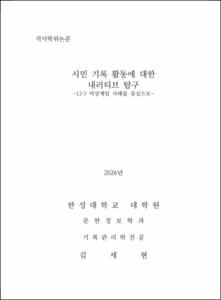
시민 기록 활동에 대한 내러티브 탐구
= A Narrative Inquiry into Citizen Recording Practices: during the December 3 Martial Law Crisis
- Type
- Thesis
- Alternative Title
- 12·3 비상계엄 사태를 중심으로
- Abstract
- 본 연구는 이야기를 통해 인간의 경험을 이해하고 삶에 대한 통찰을 이끌어내는 ‘내러티브 탐구’ 방법론을 통해, 12·3 비상계엄 사태를 기록한 시민 기록가들의 기록 활동과 그 의미를 추적하였다. 연구자는 ‘기록이란 무엇인가’에 대한 혼란과 ‘왜 이들은 위험 속에서도 기록하기를 선택했는가’라는 의문을 바탕으로 자전적 내러티브를 구성하였으며, 현장에서 만난 세 명의 연구 참여자인 민이현, 민정아, 민영주와 함께 연구 퍼즐을 완성해 나갔다.
연구 참여자들의 이야기는 각각의 개성을 살려 민이현의 수필 <두 번은 후회하기 싫어서>, 민정아의 소설 <판도라의 상자 아래에는 결국 희망이 남아 있다>, 민영주의 독백 희곡 <사람을 잇고 미래로 향하는 다리가 되어>로 재구성되었다.
연구 참여자들은 본인들이 광장에 나와 목소리를 낸 경험은 연구 참여자 본인뿐 아니라 그 공간에 함께 있던 이들이 그곳에 존재했음을 증명하고 광장에서의 기억을 남기는 것을 바라고 있었다. 또한, 연구 참여자들은 단순히 사실만을 건조하게 기록한 것이 아니라, 경험과 감정을 함께 기록하고자 노력하였다. 연구 참여자들은 기록의 동기를 유발하는 정서적, 신체적 변동인 ‘정동’에 대해 의식적, 혹은 무의식적으로 인지한 상태에서 기록 활동에 임했다. 그리고 스스로의 역사를 기록함으로써, 연구 참여자들은 당당히 기록의 주체로 변모한다. 나아가 그들은 자신이 남긴 기록이 우리 대한민국 사회의 민주주의를 지키는 한 장면으로 오래도록 전승될 것이라는 기대와, 거기서 비롯된 자부심을 가지고 있었다.
기록과 아카이브의 ‘여백’은 결코 완벽하게 보완될 수 없지만, 이 여백이야말로 기록 행위에 의미를 부여한다. 아카이브는 닫혀 있지 않고 미래를 향해 열려 있다. 이는 사람들이 여백에서 새로운 의미를 읽어내게 하고 새로운 기록 행위로 이끈다. 개별 기록은 불완전할지라도, 다양한 주체로부터 생산된 기록은 상호보완적으로 우리 사회를 이루는 일종의 퍼즐 조각이다.
본 연구는 연구자인 ‘나’의 기록에 대한 깨달음과 시민 기록의 가치를 다시 한 번 호명하며 마무리된다. 독자인 여러분은 이 이야기로 어떠한 영향을 받고, 어떠한 기록을 남기고, 어떠한 삶을 살아갈 것인가?|This study traces the recording activities and significance of citizen record producers who documented the December 3 Martial Law crisis through the methodology of “Narrative Inquiry,” which seeks to understand human experience and derive insights into life through stories. The researcher constructed an autobiographical narrative based on the confusion over “What is ‘the record?’” and the question, “Why did they choose to record even amidst danger?” and completed the “research puzzle” together with three participants met in the field: Min Yi-hyeon, Min Jeong-ah, and Min Young-ju.
The participants’ stories were reconstructed into distinct literary forms to reflect their unique characters: Min Yi-hyeon’s essay, ; Min Jeong-ah’s novel,; and Min Young-ju’s monologue play, .
The findings reveal that the participants hoped their experiences of voicing their opinions in the public square would serve as proof of existence—not only for themselves but also for those present with them—and preserve the collective memory of that space. Furthermore, they endeavored to record not merely dry facts, but their lived experiences and emotions. Engaging in recording practices, they were—consciously or unconsciously—driven by “affect,” the emotional and physical intensity that motivates the act of recording. By documenting their own history, the participants transformed from passive objects into active subjects of records. Furthermore, they held the profound pride and expectation that the records they left behind would be transmitted as enduring testimonies to the preservation of democracy in Korean society.
While the “voids” of records and archives can never be perfectly filled, these very spaces endow the act of recording with meaning. Archives are not closed but open toward the future, inviting others to read new meanings within the margins and inspiring further archival actions. Although individual records may be incomplete, records produced by diverse subjects serve as complementary puzzle pieces that constitute our society.
This study concludes by calling upon the researcher’s own realization regarding the value of citizen records. It leaves a final question for the readers: What kind of influence will this story have on you, what records will you leave behind, and what kind of life will you lead?
- Advisor
- 박진호
- Department
- 문헌정보학과
- Issued Date
- 2026
- Publisher
- 한성대학교 대학원
- Authorize & License
-
- Authorize공개

- Files in This Item:
-
-
Download
 TH_I1A6A6_시민 기록 활동에 대한 내러티브 탐구 .pdf
기타 데이터 / 4.03 MB / Adobe PDF
TH_I1A6A6_시민 기록 활동에 대한 내러티브 탐구 .pdf
기타 데이터 / 4.03 MB / Adobe PDF
-
Items in Repository are protected by copyright, with all rights reserved, unless otherwise indicated.