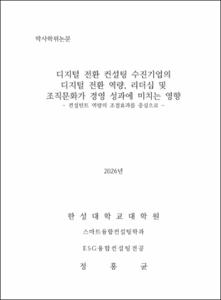
디지털 전환 컨설팅 수진기업의 디지털 전환 역량, 리더십 및 조직문화가 경영 성과에 미치는 영향
= The Impact of Digital Transformation Capability, Leadership, and Organizational Culture on Business Performance among SMEs Receiving Digital Transformation Consulting: Focusing on the Moderating Role of Consultant Competence
- Type
- Thesis
- Alternative Title
- 컨설턴트 역량의 조절효과를 중심으로
- Abstract
- The Impact of Digital Transformation Capability, Leadership, and Organizational Culture on Business Performance among SMEs Receiving Digital Transformation Consulting: Focusing on the Moderating Role of Consultant Competence
The purpose of this study is to empirically examine how digital transformation capability, leadership, and organizational culture influence business performance in digital transformation consulting client firms, and to verify whether consultant competence performs a moderating role in these relationships. Recent discussions highlight that digital transformation (DX) in small and medium-sized enterprises (SMEs) should be understood not merely as the adoption of digital technologies but as a complex organizational innovation process that requires the integration of internal organizational capabilities with external professional support. Accordingly, this study proposes an integrated structural model that includes internal organizational factors—digital transformation capability, leadership, and organizational culture—and an external expertise factor—consultant competence.
Based on prior research, the research model was developed with the hypotheses that digital transformation capability, leadership, and organizational culture would have positive effects on business performance, and that consultant competence would moderate the relationships between these three factors and business performance. To test these hypotheses, a survey was conducted with 257 consultants who delivered DX consulting to domestic SME client firms. The collected data were analyzed using SPSS 25.0 and AMOS 25.0 through confirmatory factor analysis and structural equation modeling.
The empirical results demonstrate that digital transformation capability, leadership, and organizational culture positively and significantly affect business performance. Furthermore, consultant competence was found to strengthen the relationships between digital transformation capability and performance, leadership and performance, and organizational culture and performance. These findings indicate that digital transformation performance among SMEs is not solely determined by internal capabilities but is significantly dependent on consultant competence as a key catalyst that facilitates the realization of performance outcomes.
This study provides several implications. First, SME DX strategies should expand beyond technology-centered approaches toward change management strategies anchored in organizational capability development. Second, leadership capability is confirmed to be a critical condition that accelerates DX performance. Third, organizational culture not only contributes directly to organizational outcomes but also becomes more effective when combined with external professional support. Fourth, the moderating effect of consultant competence underscores that consulting quality and capability levels are essential mechanisms determining the success of DX initiatives, suggesting the need for institutionalized consultant capability certification, matching mechanisms, and post-consulting support systems in public DX policies.
Nonetheless, this study has several limitations, including the use of cross-sectional data, the restriction of the sample to consultants, limited measurement granularity of organizational culture, the treatment of consultant competence as a single-dimensional construct, and the absence of qualitative evidence. Future research should incorporate longitudinal data, adopt multi-layered sampling that includes SME owners and employees, differentiate subdimensions of consultant competence, and combine qualitative methods to deepen causal and contextual understanding of the DX process.|본 연구의 목적은 디지털 전환 컨설팅 수진기업을 대상으로 디지털 전환 역량, 리더십, 조직문화가 경영성과에 미치는 영향을 분석하고, 이 관계에서 컨설턴트 역량이 조절효과를 수행하는지를 실증적으로 규명하는 데 있다. 최근 중소기업의 디지털 전환은 기술 도입만으로는 성과가 보장되지 않으며, 조직 내부역량과 외부 전문가의 개입이 결합된 복합적 혁신 과정이라는 관점이 확산되고 있다. 이에 본 연구는 조직 내부 요인(디지털 전환 역량·리더십·조직문화)과 외부 전문성 요인(컨설턴트 역량)을 통합한 구조적 모형을 제시하였다.
연구모형은 선행연구를 토대로 디지털 전환 역량, 리더십, 조직문화가 경영성과에 정(+)의 영향을 미칠 것이라는 가설과, 이들 요인이 경영성과에 미치는 영향이 컨설턴트 역량에 의해 조절될 것이라는 가설로 구성되었다. 이를 검증하기 위해 국내 디지털 전환 컨설팅 지원사업에 참여한 수진기업을 대상으로 활동한 컨설턴트 257명을 표본으로 설문조사를 실시하였으며, 수집된 자료는 SPSS 25.0과 AMOS 25.0을 활용하여 확인적 요인분석과 구조방정식 모형 분석을 수행하였다.
분석 결과, 디지털 전환 역량, 리더십, 조직문화는 모두 경영성과에 유의한 정(+)의 영향을 미치는 것으로 나타났다. 또한 조절효과 검증을 통해 컨설턴트 역량이 디지털 전환 역량–성과, 리더십–성과, 조직문화–성과의 관계를 강화하는 조절변수로 작용함을 확인하였다. 이는 중소기업의 디지털 전환이 내부역량만으로는 성과 창출이 제한될 수 있으며, 전문 컨설턴트의 개입과 역량 수준이 성과 실현의 핵심적 촉매 요인임을 의미한다.
본 연구는 다음과 같은 시사점을 제공한다. 첫째, 중소기업의 디지털 전환 전략은 기술 중심에서 조직역량 기반의 변화관리 전략으로 확장되어야 한다. 둘째, 리더십 역량은 디지털 전환 성과를 촉진하는 결정적 조건임을 확인하였다. 셋째, 조직문화는 단독적 영향뿐 아니라 외부 전문성과 결합될 때 성과 실현 효과가 더욱 강화될 수 있음을 시사한다. 넷째, 컨설턴트 역량의 조절효과는 컨설팅 품질과 역량 수준이 디지털 전환 성과를 좌우하는 실질적 기제임을 보여주며, 이는 정부 및 중간 지원조직이 컨설턴트 역량 인증, 매칭 시스템, 사후관리 구조를 제도화할 필요성을 제기한다.
한편 본 연구는 단일 시점의 횡단자료 사용, 표본이 컨설턴트 응답에 제한된 점, 조직문화 구성요인 측정의 일반화 한계, 컨설턴트 역량을 다차원 구분 없이 단일 차원으로 다룬 점, 질적 자료 미보완 등 다섯 가지 한계를 지닌다. 향후 연구에서는 종단적 자료 구축, 수진기업 경영자·실무자를 포함한 다층 표본 설계, 컨설턴트 역량 세부요인의 비교 분석, 질적 탐색 연구 병행 등을 통해 디지털 전환의 시간적 메커니즘과 맥락적 조건을 심층적으로 규명할 필요가 있다.
- Advisor
- 윤주일
- Department
- 스마트융합컨설팅학과
- Issued Date
- 2026
- Publisher
- 한성대학교 대학원
- Appears in Collections:
- 스마트융합컨설팅학과 > 2. Thesis
- Authorize & License
-
- Authorize공개

- Files in This Item:
-
-
Download
 TH_P1A2A2_디지털 전환 컨설팅 수진기업의 디지털 전환 역량, 리더십 및 조직문화가 경영 성과에 미치는 영향 .pdf
기타 데이터 / 1.24 MB / Adobe PDF
TH_P1A2A2_디지털 전환 컨설팅 수진기업의 디지털 전환 역량, 리더십 및 조직문화가 경영 성과에 미치는 영향 .pdf
기타 데이터 / 1.24 MB / Adobe PDF
-
Items in Repository are protected by copyright, with all rights reserved, unless otherwise indicated.