베트남 진출 한국 기업의 조직 커뮤니케이션 격차 해소를 위한 생성형 AI 활용 전략 연구
= A Study on the Utilization Strategies of Generative AI to Bridge Organizational Communication Gaps in Korean Enterprises Operating in Vietnam
- Type
- Thesis
- Abstract
- 본 연구는 베트남에 진출한 한국 기업에서 근무하는 한국인 상사와 베 트남인 직원 간에 발생하는 커뮤니케이션 장애를 분석하고 생성형 AI의 활용 이 이러한 장애를 완화하여 조직 내 갈등 감소로 이어지는지를 실증적으로 검증하는 데 그 목적이 있다. 연구 모형에서는 생성형 AI를 활용한 상황 장 애 개선을 독립변수로 설정하고 생성형 AI를 활용한 발신자 장애 개선과 수 신자 장애 개선을 매개변수로 설정하였다. 종속변수로는 업무 갈등, 과정 갈 등, 관계 갈등의 감소로 설정하였고 조직 분위기와 상사의 리더십에 따라 생 성형 AI를 활용한 커뮤니케이션 장애 개선이 달라질 수 있으므로 이를 조절 변수로 설정하였다. 이를 위해 베트남에 진출한 한국 기업에 근무하는 베트남 인 직원을 대상으로 설문조사를 실시하였으며, 수집된 자료는 탐색적 요인 분 석, 확인적 요인 분석, 신뢰도 및 타당도 검증과 구조방정식 모형 분석을 통 해 검증하였다. 조직 분위기에 따라 책임 구분을 중요시하고 상하 관계가 뚜렷하게 나타 나는 역할·권위 지향적 조직 분위기, 특정 요인이 높거나 낮지 않은 균형적 조직 분위기, 질서를 중요시하는 전통적·위계적 조직 분위기로 표본 집단을 구분하여 생성형 AI 활용이 상황 장애 개선을 통해 발신자·수신자 장애 개선 을 통하여 갈등 해소로 이어지는 분석 하였다. 또한, 상사의 리더십을 상사가 직원에게 다양한 리더십 수준을 발휘하는 특징을 보이는 고관계·고과업 리더 십 집단, 상사가 직원에게 리더십 수준이 낮게 발휘하는 특징을 보이는 저관 계·저과업 리더십 집단, 상사가 직원에게 리더십 수준이 일부만 발휘하는 특 징을 보이는 고관계·저과업 리더십 집단으로 구분하여 조직 분위기와 마찬가 지로 생성형 AI 활용이 상황 장애 개선을 통해 발신자·수신자 장애 개선을 통하여 갈등 해소로 이어지는 분석 하였다. 집단별 분석 결과 조직 분위기보다는 상사의 리더십 집단이 생성형 AI의 활용을 통한 조직 내 커뮤니케이션 장애 개선에 더 유의한 영향을 받는 것으 로 나타났으며, 조직 분위기 집단에서는 일부 생성형 AI의 활용이 갈등 해소 로 이어지지 않고 오히려 갈등을 심화시키는 방향으로 작용하는 예도 확인되 었다. 생성형 AI 활용을 통한 조직 내 커뮤니케이션 장애 개선은 고관계·고과 업 리더십 집단에서 가장 유의한 영향을 미치는 것으로 나타났고 상사의 생 성형 AI 활용은 베트남인 직원과의 업무 갈등 해소와 관계 갈등 해소에 유의 한 영향을 미치는 것으로 나타났다. 이러한 연구 결과는 생성형 AI 활용을 통한 조직 커뮤니케이션 장애 개선 이 모든 조직에 같게 적용될 수 없으며, 조직의 특성과 리더십 유형을 고려한 선택적 도입과 관리 전략이 필요함을 시사한다.
【주요어】베트남, 국외 기업, 생성형 AI, 커뮤니케이션, 갈등, 조직 분위기, 리더십|This study aims to empirically examine the communication barriers that arise between Korean supervisors and Vietnamese employees working in Korean enterprises operating in Vietnam, and to verify whether the use of generative artificial intelligence (AI) can alleviate such barriers and lead to a reduction in organizational conflict. In the research model, situational barrier improvement through the use of generative AI was set as the independent variable, while sender-related barrier improvement and receiver-related barrier improvement through the use of generative AI were set as mediating variables. Reductions in task conflict, process conflict, and relationship conflict were set as dependent variables, and organizational climate and supervisory leadership were set as moderating variables, as the effectiveness of communication barrier improvement through generative AI utilization may vary depending on these factors. To achieve the research purpose, a survey was conducted among Vietnamese employees working in Korean enterprises operating in Vietnam, and the collected data were analyzed using exploratory factor analysis, confirmatory factor analysis, reliability and validity testing, and structural equation modeling.
According to organizational climate, the sample was divided into three groups: a role- and authority-oriented organizational climate characterized by clear hierarchical relationships and an emphasis on role differentiation; a balanced organizational climate in which no specific factor is particularly high or low; and a traditional hierarchical organizational climate that emphasizes order and rules. In addition, supervisory leadership was classified into three groups: a high-relationship/high-task leadership group characterized by supervisors exhibiting high levels of both relational and task-oriented leadership; a low-relationship/low-task leadership group characterized by low levels of leadership toward subordinates; and a high-relationship/low-task leadership group characterized by supervisors partially exhibiting leadership behaviors. Similar to organizational climate, analyses were conducted to examine whether generative AI utilization leads to conflict reduction through situational barrier improvement and subsequent senderand receiver-related barrier improvement across leadership groups.
The results of the group analysis indicate that supervisory leadership groups exert a more significant influence on communication barrier improvement through generative AI utilization than organizational climate groups. In some organizational climate groups, certain uses of generative AI did not lead to conflict reduction but instead operated in a direction that intensified conflict. Communication barrier improvement through generative AI utilization was found to have the most significant effect in the high-relationship/high-task leadership group, and supervisors’ use of generative AI had significant effects on reducing task conflict and relationship conflict with Vietnamese employees.
These findings suggest that communication barrier improvement through generative AI utilization cannot be applied uniformly across all organizations, and that selective adoption and management strategies considering organizational characteristics and leadership types are necessary.
【Keywords】Vietnam, Overseas Enterprises, Generative AI, Organizational Communication, Organizational Conflict, Organizational Climate, Leadership
- Advisor
- 주형근
- Department
- 지식서비스&컨설팅학과
- Issued Date
- 2026
- Publisher
- 한성대학교 지식서비스&컨설팅대학원
- Appears in Collections:
- 지식서비스&컨설팅학과 > 2. Thesis
- Authorize & License
-
- Authorize공개

- Files in This Item:
-
-
Download
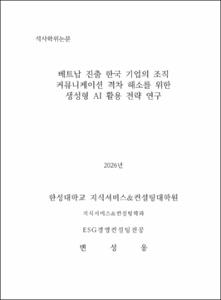 TH_P1A1A1_베트남 진출 한국 기업의 조직 커뮤니케이션 격차 해소를 위한 생성형 AI 활용 전략 연구 .pdf
기타 데이터 / 3.76 MB / Adobe PDF
TH_P1A1A1_베트남 진출 한국 기업의 조직 커뮤니케이션 격차 해소를 위한 생성형 AI 활용 전략 연구 .pdf
기타 데이터 / 3.76 MB / Adobe PDF
-
Items in Repository are protected by copyright, with all rights reserved, unless otherwise indicated.